
Website Updates in Progress. We are making updates to improve accessibility. Thank you for your patience.
America's Job Center in Deming will be closed from 12 PM to 1 PM on Friday, October 16, 2026.
*** America's Job Center at 226 S. Alameda Blvd. in Las Cruces is undergoing renovations. ***
America's Job Center in Las Cruces is temporarily providing services at
Loretto Towne Centre, 505 S. Main St., Ste. 149. Hours are 8 AM-12 PM & 1 PM-5 PM.

Southwestern Area
Catron • Doña Ana • Grant • Hidalgo • Luna • Sierra • Socorro Counties
WIOA Youth Virtual Orientation Update
Effective July 1, 2026: Online registration for our Youth Virtual Orientation is temporarily paused due to a program transition.
If you are interested in applying for youth services, please do not use the registration link below. Instead, please contact:
Teofilo Ugalde
Phone: 575-527-7756 or 575-527-7776
Email: TUgalde@dacc.nmsu.edu or ctp@nmsu.edu
Virtual Orientation
Follow These Steps to Get Started
Step 1: Register with NM JOBS
To participate in career or training programs, you must have an active account in the New Mexico Jobs Online System (NM JOBS).
Use the button below to go to the NM JOBS website and create an account.
(If you already have an account, continue to Step 2)
After registering at NM JOBS, return to this page and continue to Step 2.
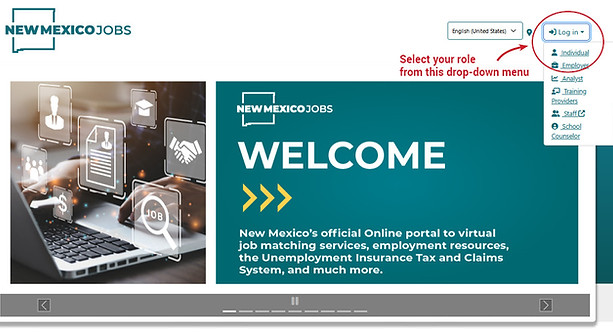
NM JOBS is an external website.
Step 2: Review Program Information
Review the information below to determine if you would like to move forward.
Step 3: Register for a Virtual Orientation
To begin the enrollment process, register for a virtual orientation to learn about eligibility requirements and program expectations.
Program Information
Ready to Start Your Career Journey?
Register for our weekly virtual orientation to learn more about the Adult & Dislocated Worker programs.
Register for Participant Orientation (opens in a new tab).
Are you a Local Employer?
We offer no-cost hiring support, wage reimbursements, and customized training for your workforce. Register for an Employer-specific orientation to see how we can partner with your business.
Register for Employer Orientation (opens in a new tab).
Tuition Assistance
Through the Workforce Innovation and Opportunity Act (WIOA), you may be eligible to receive up to $15,000 in federal funds (not a loan) to help pay for a degree or certificate program.
View Tuition Assistance Details.
On-the-Job Training (OJT)
Earn while you learn. We partner with local employers to help you get hired and receive hands-on training while receiving a paycheck from day one.
View On-the-Job Training Information.
Youth Services (Ages 16-24)
Jumpstart your future with career exploration, life skills experience, and educational support tailored for young adults.
View Youth Services Information.
Frequently Asked Questions
What is WIOA?
The Workforce Innovation and Opportunity Act (WIOA) is a federal law designed to help job seekers access employment, education, training, and support services, and to match employers with skilled workers.
Is there a cost to participate?
No. WIOA services are provided at no cost to eligible individuals.
What initial documents do I need for eligibility?
To begin the process, you will need to provide:
-
Proof of Identity and Work Authorization: Such as a U.S. Passport, Permanent Resident Card, or Social Security Card.
-
Age Verification: Birth Certificate, Driver's License, or State/Federal ID.
-
Proof of Residency: Utility bill, lease agreement, or driver’s license with your current address.
-
Selective Service Registration: Required for males ages 18-25.
-
Income Verification: Required if applying under low-income priority; acceptable documents include pay stubs, tax returns, or public assistance award letters (TANF, SNAP).
Who is eligible for the Adult and Dislocated Worker programs?
-
Adults: Individuals 18 or older, with priority for those receiving public assistance or considered low-income.
-
Dislocated Workers: Individuals who lost their jobs due to layoffs, plant closures, or economic conditions. This also includes displaced homemakers or military spouses who lost employment due to relocation.
What are the eligibility requirements for the Youth program?
The Youth program serves individuals ages 14–24 (In-School) or 16–24 (Out-of-School) who face one or more of the following barriers:
-
School dropout status.
-
Homelessness or living in foster care.
-
Pregnant or parenting.
-
Involvement in the justice system.
-
Individuals with a disability
How long does the process take?
This depends on you. The faster you return the requested documents to your Talent Development Specialist, the faster you will move through the eligibility process.
What is my commitment to the program?
Your success depends on how much you are willing to put into it. You can expect to meet on a regular basis with a Talent Development Specialist to work toward your goals. We also provide follow-up support for one year after you complete your training.
Who is considered a "Dislocated Worker"?
You may qualify for this specific program if you:
-
Have been laid off or received a layoff notice.
-
Are eligible for or have exhausted unemployment benefits.
-
Are unlikely to return to your previous industry or occupation.
-
Lost employment due to a plant closure or substantial layoff.
-
Are a displaced homemaker or a spouse of an active-duty military member who lost employment due to relocation.
Specific Barriers for Youth Services
The Youth program (Ages 16-24) is designed for those who face one or more of these barriers:
-
School dropout (Out-of-School Youth).
-
Homeless or in foster care.
-
Pregnant or parenting.
-
Involved in the justice system.
-
Individuals with a disability.
What services will I actually receive?
Once enrolled, you can access:
-
Career Services: Job search assistance, career planning, and counseling.
-
Training Services: Funding for occupational skills training, certifications, and on-the-job training (OJT) opportunities.
-
Supportive Services: Financial assistance for "barriers to work," such as transportation, childcare, uniforms, or tools required for your new job.